Storytelling: The Oldest and Most Effective Language Development Tool
Throughout human history, storytelling has been the most fundamental means of knowledge transfer and communication. Today, science confirms what our ancestors intuitively knew: storytelling powerfully supports children's language development. Brain imaging studies have shown that when children listen to stories, brain regions associated with language, memory, and empathy become active.
Storytelling develops not only language but also imagination, emotional intelligence, attention span, and social skills. A story creates a complete learning experience in the child's brain.
How Listening to Stories Affects the Brain
Neurological Perspective
An extraordinary process occurs in the child's brain while listening to stories:
- Broca's area (language production) and Wernicke's area (language comprehension) activate together
- The amygdala engages during emotional scenes, strengthening emotional memory
- The visual cortex activates during descriptive passages — the child "watches a movie in their mind"
- The motor cortex responds when movement and action are narrated
This multiple brain activation makes storytelling a much more powerful learning tool than simple vocabulary memorization. Words learned during a story become much more lasting because they're connected to multiple brain regions.
Attention Span and Stories
Children have short attention spans, but an engaging story significantly extends this duration. Research shows that children who regularly listen to stories have 30% longer attention spans. This skill benefits not just story listening but all learning processes.
How Storytelling Contributes to Language Development
1. Expands Vocabulary
Stories offer a rich world of words not used in everyday conversation. Words like "enormous," "tiny," "once upon a time," and "enchanted" expand the child's language universe. Research reveals that children who regularly listen to stories have vocabularies 50% broader than their peers.
2. Teaches Sentence Structure
Sentences in stories are more complex and structured than everyday speech. Sentences like "The little rabbit said goodbye to his mother and started running toward the forest" provide models for building long sentences.
3. Develops Narrative Skills
Stories have a beginning, middle, and end structure. Children internalize this structure and learn to narrate their own experiences in a sequential and coherent manner. Connection patterns like "First... then... finally..." are naturally learned from stories.
4. Strengthens Listening Skills
Listening to stories develops active listening skills. The child must focus attention, remember characters, and make connections between events. This skill directly impacts classroom listening ability during school years.
5. Supports Abstract Thinking
Imaginary elements in stories — talking animals, magical objects, distant lands — develop the child's abstract thinking skills. This skill forms an important foundation for future areas like mathematics, science, and creative writing.
Age-Appropriate Storytelling Suggestions
Ages 0-1: Rhythm and Sound
During this period, the melody and rhythm of the voice matter more than story content. Short rhymes, lullaby-format stories, and narrations with sound imitations are ideal. Use simple repetitive patterns.
Ages 1-2: Short Illustrated Stories
Short stories supported by large, colorful pictures are suitable for this age. One to two sentences per page is enough. Do interactive narration by pointing to pictures.
Ages 2-3: Simple Plot
Tell short stories with a simple problem and solution. Stories with repetitive structures work perfectly: "The Three Little Pigs," "Little Red Riding Hood." Involve the child: "Who do you think knocked on the door?"
Ages 3-5: Rich Stories
You can tell longer and more detailed stories. Tales with multiple characters, emotional depth, and unexpected twists capture this age group's interest. Encourage the child to contribute: "What would you do?"
Effective Storytelling Techniques
Use Voice Changes
Use different voice tones for each character. Deep voice for the bear, high voice for the rabbit. Voice changes bring the story to life and increase the child's attention.
Use Pauses
Pause at exciting moments: "And when she opened the door... (pause) ...she saw a huge bear!" Pauses create curiosity and encourage the child to make predictions.
Add Facial Expressions and Gestures
Tell the story not just with your voice but with your face and hands. Expressions of fear, surprise, and joy make the story more impactful and support the child in learning emotion words.
Do Interactive Storytelling
Involve the child in the story. Ask questions, have them predict, make sound effects together. Interactive storytelling supports language development 2 times more than passive listening.
Digital Story Tools
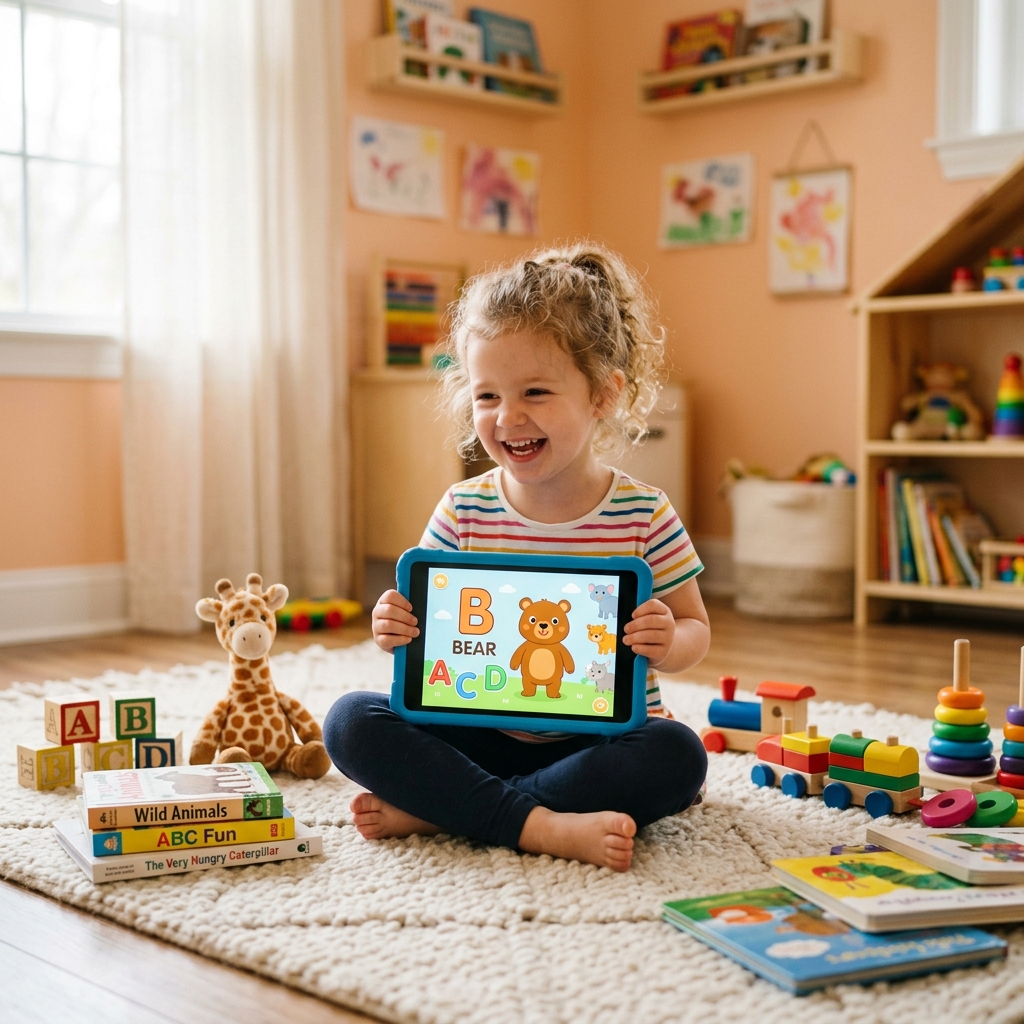
In addition to traditional storytelling, technology can enrich the story experience. Konus Benimle's AI-powered story creation feature generates personalized stories using words the child has learned. This way:
- Each story matches the child's vocabulary level
- Learned words are reinforced in story context
- Infinite story variety is provided
- Story experiences are offered in 3 languages (Turkish, English, German)
Digital stories don't replace traditional storytelling but powerfully complement it.
Creating a Daily Storytelling Routine
Suggestions for incorporating storytelling into your daily routine:
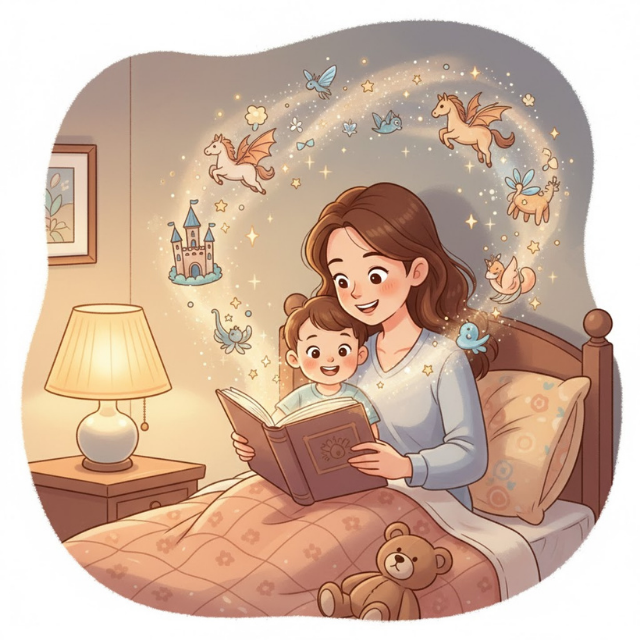
- Before bedtime: Classic story time — the most effective and common method
- During car rides: Perfect opportunity for bookless storytelling
- During meals: Share short, fun stories
- At the park: Create spontaneous stories inspired by surroundings
Conclusion: Every Story Is a Seed
Storytelling is a seed you plant in your child's language world. Every story expands vocabulary, strengthens sentence structure, nourishes imagination, and develops listening skills. With traditional tales, stories you create yourself, and AI-powered modern tools, you can comprehensively support your child's language development.
Konus Benimle generates personalized stories with AI, helping your child reinforce learned words in meaningful contexts. A story told every night before bed — whether traditional or digital — is the most beautiful investment in your child's future.
Once upon a time — and every story opens a new page in a child's language world.